Pages

Monday, August 26, 2013

What just happened?

“What just happened?” is the question in my mind presently. With only a few days left in Mozambique, I have time to think about what my life has been in the past few months. Risking hyperbole, 2013 so far has been the most intense year of my life. Looking back on it, the good and the bad, I am reminded that God was with me. God is with me. God is with us.

God was with me when my days were spent in the library, completing my honours thesis and studying. I think of the days when I was feeling discouraged with all I had to do and then finding an anonymous “AcadiaU Compliment” for me on facebook, seemingly at just the right time when I needed to be encouraged. God is good.

God was with me as I got my very first car. I think of the day the clutch gave out as we were driving home on an old country road. It happened to be right next to a very hospitable family’s home, and we were able to start doing “Soularium” cards with them.  Later, local Mennonites were able to fix my car for a really good price. God is good.

And I am sure God celebrated with me when I walked across the University Hall stage to get an undergraduate degree, despite the sorrow of losing a classmate so soon before graduation.

God was with me when I was trying to raise the support to go on the Halifax Urban Partnership and on this Wycliffe internship. He provided for these things in marvelous ways, in the perfect timing. I think of the day before I left for Mozambique. “I only need X dollars more,” I mentioned to a visitor to our house. “Oh,” she said. “I just donated X dollars.” God is good.

He was with me and my family when we had to say goodbye to my grandmother this spring. It turns out that just because you expect someone to die, it doesn’t mean you miss them any less when they are gone. God comforted us through His Word and through supportive family and friends. I think of the friend who got Bob Goff, author of one of my favourite books, to leave a voicemail with his condolences. I think of the friends who stepped up to take care of some of my Acadia Christian Fellowship responsibilities when I was not able to do them. God is good.

God was with us at MarkEast when we made time to study His Word. And He was with us in Halifax. I think of an incident that happened on the HUP when one of the team members had a ukulele taken from the church where we stayed. I saw God’s presence in our team in a beautiful way when we befriended the suspected thief, showing God’s grace and forgiveness despite our own conflicted feelings, and when we later chipped in to replace the lost ukulele. God is good.
Hupsters=love
And God is with me in Mozambique. As it happens, He provides more than just basic needs like food and shelter—he has also provided me with good friends here. When I came, I did not think there would be anyone my own age. But it turns out there are two other girls staying in Nampula for around the same amount of time I am. I have been blessed by their companionship. God is good.
The three of us in Nacala (note: these ladies are pretty good sports to allow this photo to be taken, as it was 6am!)

God was with me when I prayed for someone to help me with Portuguese, and also when I prayed to have a Mozambican friend. He answered both of these prayers with the same person. Flora is also around my age, and she helps me in my language learning. The story of how we met her is a funny one. We were on our way to Nacala with a Mozambican coworker, his wife and their friends, when the truck broke down. So we were stranded on the side of the road in an unfamiliar place for a couple of hours. As we were standing by the truck waiting as the men tried to fix the problem, a Land Rover full of missionaries drove by. Surprised to see three white girls, they stopped. It was an American family. In fact, the woman had been trying to get a hold of my two friends—this family had recently moved to Nampula, and their language helper had also happened to move, because she was now attending university here. The reason this American woman was trying to contact my friends is because Flora is a native speaker of Chuwabu, the very language my friends want to learn! So as a result of that chance meeting on the side of the road, we were able to meet with Flora. Now she helps my friends with Chuwabu and me with Portuguese. God is good.
Flora and me

So, soon it is back to Wolfville, where I have no idea what I will be doing. But I do know one thing: God will be with me. As the Chris Tomlin song goes: “I know who goes before me/I know who stands behind/The God of angel armies/Is always by my side.”

“And remember, I am with you always, to the end of the age”

-Jesus (Matthew 28:20)

Monday, August 19, 2013

Small town girl in the city

“I don’t want to live in a city,” I have always told people, and it is true. I am a person easily overwhelmed with the constant assaults to the senses that are found in the city. I have an irrational fear of public transportation, I hate the feeling of walking along the sidewalk and feeling pushed along by a crowd, and it stresses me out to hold my purse tightly against me for fear of thieves. Because of my upbringing, it is no surprise that I prefer small towns and rural areas, where drivers actually stop for pedestrians and where the natural world is nearer. I don’t want to live in a city, I said.

This summer I have lived in two cities.

In May I lived in Halifax with a joyful group of university students and leaders. We focused on the invisible of the cities, the marginalized ones, the victims of this unjust world. I think those people are the most interesting and cool. Spending the month in Halifax made me appreciate the city more. One of the things that most bothers me about cities is the feeling of inadequacy I get when I walk through them. I begin comparing myself to others: the fashionably dressed ones, the people talking on their cell phones while hurrying down the street, the people who actually know what bus they want to go on. And I inevitably feel like the clueless one, like the new kid in class with no one to show her the ropes. But hanging out with the folks at the drop-ins and on the street was refreshing. These people are unpretentious and interesting and if they were my friends I think I could change my mind about living in the city. Being in Halifax made me lose my idea that we are either “City mice” or “country mice” and reminded me that we are all just humans in the end.
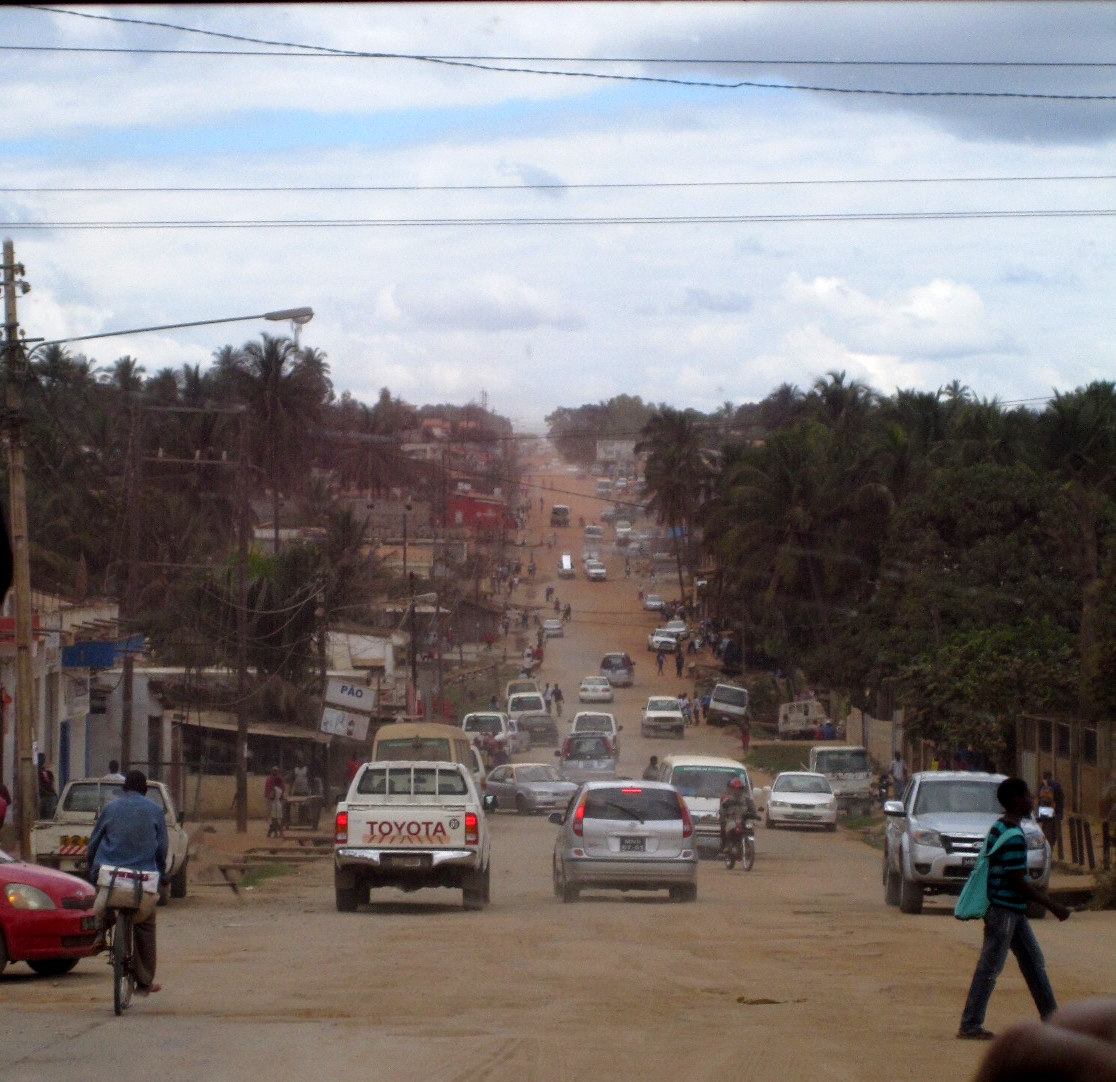
For the past few months I have lived on the outskirts of Nampula, the capital of the same-named province in Mozambique. The living situation here is a sort of mission compound, and I only go into the city once or twice a week. For the first couple months, every trip into town was really stressful, and I could not go to the market without getting a headache. If I find Halifax—the familiar, small city—overwhelming, imagine how I feel about Nampula! Take my initial antagonism towards cities, multiply that by a language I don’t know and add people shouting “Hakuna” (white person), men catcalling marriage proposals, guards carrying machine guns, people peeing on trees on the sidewalk and crazy motorcycle drivers and this equals a totally overwhelmed Hannah.

Somehow I survived, and now I can go into the city, even on public transportation, without tensing up as if I am about to write a mathematical economics exam. I still do not think I would like to live in a city for my whole life but this one is growing on me. For instance, the other day a friend and I were crossing a busy street that is part of the rotunda. We did not want to cross when it was unsafe so we just stuck close to a couple of stooped, barefoot old women. The women thought we were so funny and had a nice laugh out of it as we finally crossed the street together at a safe time. I love these moments that remind us that despite differences in age, ethnicity, social status and language, we are still human.

There is no longer Jew or Greek, there is no longer slave or free, there is no longer male and female; for all of you are one in Christ Jesus. (Galatians 3:28)
Nampula
The rotunda

No road rules
Just had to add a couple of sunset photos


Monday, August 12, 2013

A Day in the Life

The thing about being here is there is no typical day. But I am just going to pretend there is such thing as one and give you a summary of what my life was like today, for example. So, here’s how it goes:

6:28am: My alarm goes off
6:50am: I actually get up (some things are the same in Nova Scotia and Mozambique). I lift the mosquito net away from my bed and get myself ready for the day. I make sure not to brush my teeth with the tap water, and the clothes I wear are such typical missionary attire it’s not even funny: my outfit includes a long skirt and Birkenstocks.
7:30am: Prayer meeting in the office. A different office worker leads the meeting each day (in Portuguese) and we pray in the typical Mozambican style: everyone prays at once, all saying different things.
8am: My American colleagues and I have a meeting with our supervisor, the linguistics consultant for the branch. We discuss what we’ve done and what we will do this week. Right now we are analyzing some texts in Chuwabo (a language spoken in Zambezia province). We are also working on translating and publishing grammatical notes on various Bantu languages. These will be used to help Bible translation and literacy efforts.
10am: After getting some tea or coffee, we go to the office we share.  
"Linguistics task force" hard at work

12pm: Lunch time! In our house, this generally includes rice, meat, and salad. My favourite is the fruit we eat after the meal: fresh bananas, tangerines, and sometimes pineapple. Of course the meal is followed with a digestive cup of tea.
1pm: We take a walk around the SIL centre.
1:30pm: Back to work in the office
3pm: On Tuesdays and Thursdays I have one hour of Portuguese lessons with my tutor, Flora. She is a Mozambican woman around my age. Today, however, we take a break from office work and go to the English school to help move a bunch of books from one building to the library. This involves cleaning the books, putting them in boxes, moving the boxes, unpacking the boxes, and labeling and shelving each book. I feel very much at home doing this task because it reminds me of my first job as a student clerk at the library.
5pm: Finishing the work at the library, I go outside and see a beautiful sunset which I cannot help but photograph. And I thank God that I live in such a beautiful place Then I write a blog post…. As I write it, I hear the prayer call in the nearby mosque. I usually say a quick prayer for the Muslims in the area at this time, that they will come to know Christ. I also conclude, though I am a bit biased, that of all the major world religions, Christians have the best music. The joyful singing in church here, to me, sounds way better than the droning I hear from the mosques.
This is where I live

Every day

Am I making you jealous?

5:30pm: I go back to the house I live in with an English couple. We just moved in! But of course they will stay longer than I will. I eat the meal they call “tea,” which here includes, naturally, tea, and a roll with cheese and tomato on it, or maybe peanut butter and jam.
My Mozambican home

Then the evening is free. Some nights we have Bible study, or are invited over to someone’s house for supper. I have spent many nights watching Downton Abbey at my friend’s house, just a short walk away. Every time I go out after dark I try to make as much noise as I can, often singing to myself, because I want to alert any snakes to my presence. I have yet to see a snake though.

Peace and love, all!


Bible translation needs at a glance


Monday, August 5, 2013

Shalom

Shalom is a Hebrew word we use to mean “peace”, and that can also be used in speech as a salutation. But the meaning of the word encompasses much more than just “peace.” Some other English words we use to describe this concept are completeness, soundness, welfare, health, prosperity, contentment, or friendship. A favourite benediction of mine is from Numbers 6:24-26

The Lord bless you
and keep you;
the Lord make his face shine on you
and be gracious to you;
the Lord turn his face toward you
and give you peace.

Peace. I think of this as a rightness of the world, a contentment that all is well, and for me, an awareness that where I am is where I should be. Though the word shalom is not used, Philippians speaks of “the peace of God, which surpasses all understanding.”

This week I felt this peace. It is good.

Let us pray for peace for Mozambique. Not just the absence of war, but rather shalom. Though there is not war, there is still darkness here. The other night, I was trying to get to sleep when I heard a series of gunshots. In the morning, I heard that there had been a violent incident nearby involving the police, and one person had been killed. We must pray for shalom.

Yesterday at church, the woman sitting next to me was holding the most adorable fat baby, with whom I promptly fell in love. This is shalom: fat babies. One does not often see that here. Children living past their fifth birthday: that is shalom.

This past weekend, I was able to see a few examples of shalom here in Mozambique.

Sports day
On Friday we got to help out with sports day at the kindergarten. This class is taught in English by a feisty American woman in her 70s. For their last day of school they had a sports day that included races, an obstacle course, a beanbag toss, long-jumping, and a dribbling contest. The kids were very excited and the parents came to watch. One tiny girl won the long-jumping contest, jumping even longer than the measuring stick would reach, and with the celebration after this, one would have thought she had just won an Olympic gold medal. It was a purely joyful moment. Though there are only 12 students, this kindergarten is attended by kids from all over the world. They get to experience something really great: having friendships that transcend borders.
The winner of "jump the river"

On Sunday I went to a church that is on the edge of town on a hill. One of the pastors took us to the top of the hill and there was a beautiful view of the houses and the plain below. Even though the church is only half-built, they still meet in the corner of it that has a roof. My home church in Truro wants to build a new building, but we are waiting to sell the old one and to raise enough money. May I suggest we do it the Mozambican way instead? Don’t wait until you have enough, just build as much as the church as you can until you run out of money!
Part of the church with a roof
Part of the church without the roof
Also at this church, we sang a song that sounded familiar to me—then I realized, it was the Makuan version “Hakuna Mungu Kama Wewe,” a song I learned at an Inter-Varsity retreat. I love the song and every time we would sing it in Canada I used to think “I need to go to Africa.” So actually hearing it in Africa was a dream come true.
Some views from the top of the hill


Hearing that song made me think of all my friends back in Canada (not that I don’t think of them a lot, because I do), and so it was very fun to Skype with my brother and some friends last night. They were at Malagash and they even showed me the view from the deck (sigh) and took the laptop on the trampoline! Modern technology is the bomb. I can be at camp and in Mozambique at the same time, which is really the ideal situation when you think about it.

Shalom, loved ones. 
The staple carb here is xima, made of corn or manioc. Here I am eating it with matapa, a peanuty sauce with greens

Monday, July 29, 2013

We are prophets of a future not our own

It helps, now and then, to step back and take a long view.
The Kingdom is not only beyond our efforts,
it is even beyond our vision.
We accomplish in our lifetime only a fraction
of the magnificent enterprise that is God’s work.
We cannot do everything, and there is a sense of
liberation in realizing this.
This enables us to do something, and to do it very well.
It may be incomplete, but it is a beginning,
a step along the way, an opportunity for the Lord’s grace to enter
and do the rest.
We may never see the end results, but that is the difference between
the master builder and the worker.
We are workers, not master builders; ministers, not messiahs.
We are prophets of a future not our own.
-Bishop Ken Untener

At the church in Nacala
The Fiel conference, attended by about 300 Mozambican pastors, was held this past week at the SIL Centre
We helped to serve meals

Fresh rolls are on sale on the side of the road pretty much everywhere. I wish I could take photos of smells and tastes; YUM!

Monday, July 22, 2013

True greatness

Then they came to Capernaum; and when he was in the house he asked them, “What were you arguing about on the way?” But they were silent, for on the way that had been arguing about who was the greatest. He sat down, called the twelve, and said to them, “Whoever wants to be first must be last of all and servant of all.” Then he took a little child and put it among them; and taking it in his arms, he said to them, “Whoever welcomes one such child in my name welcomes me, and whoever welcomes me welcomes not me but the one who sent me.”
-Mark 9:33

“I once thought the disciples were slow, but not now. I now think that the real challenge of Jesus was not a matter of intelligence but ultimately a challenge to give up an old vision and to accept a new one.”
-John Powell

A few months ago, I was at a retreat for university students on the east coast, where we studied the book of Mark for a week.  It was called MarkEast, which is really pretty intuitive when you think about it. Today, I am not longer a university student, and I am no longer on the east coast. I am in Mozambique but I still the things I learned at MarkEast and the subsequent month in Halifax are sinking in. Studying the book of Mark I wondered over and over again “Why don’t the disciples get it?” Now I am asking myself that question: “Why don’t I get it?” Even after learning about true greatness, I still want greatness for myself. Even as a Christian, I find myself wanting to be the next Mother Teresa known for doing good works or C.S. Lewis known for insightful and intelligent writing. But then I remember. This is not what greatness is to Jesus.
During my time in Halifax and in Mozambique, I have met many truly great people. These people won’t get a Nobel Prize or be on the cover of Time Magazine. They won’t be interviewed by Ellen and when they die Elton John won’t write a song about them.  But the Kingdom of God isn’t like this world. Jesus honours the humble.

People like Mrs. I. To tell the truth, her name escapes me. I can’t even remember how many children she’s had. But that does not change the fact that I am humbled and honoured to have met her. This woman is the mother of one of the Mozambicans who works in the office with us. The other weekend we three meninas accompanied our coworker and his wife to a church conference in his hometown of Nacala. We were graciously hosted by Mr. and Mrs. I. Here is a woman who has lived through Portuguese colonization, a brutal civil war, and a time when Mozambique was considered the poorest country in the world, all the while raising a family and serving in the church. And she treated us, as strangers, with the utmost respect and kindness, feeding us a veritable feast. For some reason she was rather fascinated with the quiet Canadian. She told me she had a grandson who was perfect for me. She liked me even though I was just a stranger enjoying her hospitality. I could not even offer conversation because my Portuguese is extremely weak. But still, the woman treated me like an old friend. I hope I can be that willing to offer folks my respect and love. As we were loading up the truck to leave on Sunday after all the goodbyes and I was about to get in the truck, Mrs. I said something to me. I couldn’t understand her so I looked questioningly at her son, my coworker. In broken English he tried to find the words for what she had said, something that apparently does not directly translate. “She said… you’re like… a sister.”  I smiled at her as we drove away, and I couldn’t help but be in awe. How I wish I could be like Mrs. I! What a faithful mother, servant of Christ, and hard worker. She has doubtlessly lived through more sorrow than I will ever know. And yet she can still see a sister in a silent young stranger. I know that as a white person, Mrs. I could have felt angry and resentful against me. But she chose love. And even though I do not know this woman very well, I suspect that her life has been a long exercise in the habit of choosing love.
My colleague's parents

Great men and women are found everywhere.
Sunset on the way back from Nacala
Beware of baobabs
The beautiful city of Nacala