Pages

Saturday, July 8, 2017

The rural in fiction: The Channel Shore

As many of you know, my studies concentrate on rural areas, especially in Nova Scotia. I am interested in how rural areas can be ecologically, socially, and economically resilient. Currently, I am working on a project on rural youth outmigration. These are all topics I am passionate about.

As a side project, this summer I am reading some books that have similar themes as my research. I am interested in seeing how these same issues that I read about in academic journals are presented in fiction. Plus, I love to read, and I love Canadian literature! Two of my favourite books with these sorts of themes are The Mountain and the Valley by Ernest Buckler and No Great Mischief by Alistair MacLeod. I would like to write a blog post on those books but I have not read them in a while.

Recently, though, I finished Charles Bruce's novel The Channel Shore. It was the only novel he wrote, as he was a poet and journalist primarily. Charles Tory Bruce was born in Port Shoreham, Nova Scotia. Yes, I had to look it up too! It is near Guysborough. I thought it was appropriate to read this book because I ended up going to that area of the province last weekend for the Stan Rogers Folk Festival. Both Stan Rogers and Charles Bruce created art about that shore. My first time there was a couple of years ago when I had a job interview in Guysborough. Obviously, I did not get the job. This time when I went to that shore, it rained for three days straight, and was windy and foggy. On the fourth day the sun appeared. Then we left.
The road to Canso

I do not want to give away the main plot points in novel, in case you wish to read it, but I can say it is about three families: The Gordons, the McKees, and the Marshalls. It is the story of generations of these families, from the early 20th century to just after the Second World War. They are fishing families or farming families, Catholic or Protestant, but they all make their home on the Channel Shore. Bruce describe's his Channel Shore as anywhere on that channel between Cape Breton and Mainland Nova Scotia. The place names in the book are fictional.
Guysborough waterfront

I am not a book critic or literary theorist or anyone remotely qualified to analyse novels at all. I was an English major for all of two months in university before switching to what I thought at the time was a more objective major, economics. But, this is the information age, guys! Anyone can publish anything they like on the internet. Woo hoo! So, here goes, my observations on this book.

  • Gender-wise, this novel was about men, centred on men, and women for the most part were secondary characters, mainly victims of men's choices, or, in the case of Grant and Hazel, maidens whose rescuing was less about them and more about the atonement or whatever of the man rescuing. I loved the book, but it can be exhausting as a woman to never be able to see oneself in literature, and to always be 'the other.' You know women are always imagining ourselves as men because we have to. We read Harry Potter and Lord of the Rings and all those other books but it is far rarer to see a man reading Pride and Prejudice or Twilight and for him to be putting himself in a woman's shoes.
  • The main theme of this book, I think, was the character's realization of being a part of their community. Each main character (except, importantly, Anse) had a moment of clarity when they saw their life as being part of the life of the shore. This interconnectedness and interdependence with people geographically and through time was a focus of the book. It was this feeling of being part of something bigger than oneself that motivated the characters, that allowed them to stay. Below is Margaret's experience of this:
 "Margaret had a picture of young men cutting white pine for two-masters, gathering chips for their cresset fires, shaving staves, bending hoops, shingling roofs, replacing sills, fashioning window-frames, cutting sails, caulking seams, cleaning and salting fish, knitting and mending nets... they had known it all, all the skills. They were dead, and the skills gone on a turning tide. 

And yet, people remembered. And people still lived on the Channel Shore, people with others skills, newer crafts, that somehow were related to and grew from the old. The story of the Shore was the story of a strange fertility. A fertility of flesh and blood that sent its seed blowing across continents of space on the winds of time, and yet was rooted here in home soil, renewed and re-renewed.

The thought turned. All these people had faced circumstance, had known love, anger, compassion. Some of them had faced frustration as hard to bear as that which faced herself and Alan. The sense of time and home and people could do nothing to ease the sharpness of that private hunger. But there was something, a feeling strange to Margaret, a feeling almost of companionship..."

  •  In the book, we also read about the precarious social relations in the rural community, and how the people in the community carefully keep up the equilibrium. Catholics and Protestants do not mix more than necessary; when a secret threatens one of their own, they keep the secret for decades. 
  • I am not sure what to make of the staying/leaving and the representation of the urban in this book. When Anna goes to the city, she violently dies in a random act when a streetcar runs over her. That seems like a thoroughly unambiguous representation of urban as evil and dangerous. But others go away with no real consequences: Bill Graham, for example, lives primarily in Toronto, with only brief visits to the Channel Shore. Others go to Europe to fight in the wars. At the end of the book, the narrator writes about Bill Graham, who has spent the least time on the Shore of any of the characters:"He had also the knowledge that in blood and spirit this was the country he belonged to. He would never live on the Channel Shore. But it was home." 
  • So I do think this novel is mainly about belonging. Anse chooses not to belong. Alan and Grant choose to belong. Even Bill Graham, who, like Anse, spends most of his time away from The Channel Shore, chooses to belong. In Bruce's created world, belonging does not depend on family, on religion, or even on whether you leave the shore or stay. It depends on the mutual respect and love you have for your neighbours.
As I was finishing this book, I came across a video on the internet about a documentary that BBC Scotland just released. It is a documentary about The Hector, a ship that carried nearly 200 Scots to Nova Scotia in 1773. I only watched a brief clip of the documentary, as the whole thing is not available in Canada, but I was struck by the description of the ship, which was meant to be a cargo ship but housed these people in their long voyage across the Atlantic, to their new life. I had been to the replica of the ship. but looking back on it now, it shocks me how many people fit down there. It was such a small place.

My great-great-great-great grandfather Andrew Main made that crossing. He brought his wife, Jane Gibson, and his young son Andrew. Jane died sometime during the crossing. After he arrived in Nova Scotia, Andrew Main came to Noel Shore. There he married again (she died), then married again and had children. He built a homestead. He was buried in the cemetery in Noel Shore, and I believe it is the same cemetery where my grandparents are buried, a cemetery just on the edge of the Main land. I lived in Noel Shore until I was about five years old.

Sometimes, when I go to visit my uncle who still lives in Noel Shore, on that same land where Andrew Main settled all those years ago, my dad and my uncle and whoever else is there sit around the big kitchen table and share stories. They have these shared stories, this shared knowledge that I will never know. They talk about places using references only people from the Shore would know. They talk about people in such an intimate way, and have this shared remembrance of the people of the Shore. They know all the same people, they know all the same places. And I know if they ran into anyone who lived in the Shore during their generation they could share that same private knowing, that same bond.
The Noel Shore, as depicted by Kenneth Spearing
I really mourn having lost this. I still have such a deep connection to that Noel Shore that I can barely put into words. I spent only a few years there as a young child, but my ancestors spent over two hundred years there before then. My ancestors made incredibly sacrifices just to come and stay in Noel Shore, Nova Scotia. And yes, it would be remiss of me not to mention that this land was home to the Mi'kmaq people long before my ancestors landed there, and even the Acadian people before them. They were not the first.

This connection to Noel Shore is an enormous part of why I am studying rural places. I know that the people there have made immense sacrifices to be there. They have worked hard. There is a deep connection to place and I do believe that something essential is lost when people are uprooted from this place. I wonder if Charles Bruce wrote The Channel Shore as a way to articulate that feeling: To articulate that though he was cosmpolitan, living in Toronto, working as a poet and a journalist and not a fisher and a farmer, that he was still part of that community. That the Shore never leaves you.

Sunday, May 14, 2017

The fiddleheads

Mary and I picked fiddleheads yesterday.

We forage fiddleheads yearly, in May, when the ferns are beginning to sprout from the ground, but before they unfurl. I enjoy this annual ritual, in the same way I enjoy cooking stew in the woods with my church community. It is a simple act, but a unique one. It is one that I know not everyone has the privilege to partake in, and so I feel a certain responsibility to enjoy it, and to continue to do it.

Fiddlehead foraging is a contemplative practice. We park the car at the end of the road, and walk in on the path, along the riverbank and the old railway. The day we pick fiddleheads is one of those magical days at the cusp of spring, when we aren't quite used to sunny, warm days and so the weather catalyses in us a kind of glad hysteria. We walk, buckets in hand, along the red dirt way. We cross the marsh and the squishy, wet ground reveals each flaw and crack in our rubber boots. My feet get wet. Then, near the apple tree not quite in bloom, we look down. We crouch. And there around us are fiddleheads: dark green shoots not yet ready to pick, long lighter green plants that have almost reached full maturity, and in between, the ones we like. In groups of three or four are young ferns, big enough to emerge from the ground, but still short enough to not really have leaves yet and still, in many cases, covered in a brown film. It is not hard for us to find an abundance of fiddleheads. We separate, Mary by the river and me among the brush, and here is the contemplation. I hope I can communicate well the beauty of picking fiddleheads. It is like a prayer. I am on my knees, or squatting close to the ground. I hear the swell of the river and the song of birds. I am saved, then, from the noise of every day life: none of the usual humming of a refrigerator or car engine and no impulse to check twitter again.

In this space of contemplation, I think of the lesson of the fiddleheads. They are not cultivated by humans. They simply grow as part of a complex, resilient ecosystem. But at the same time, I get to take them. Though I have had no part in creating them, I have a part in consuming them. There is a way to pick fiddleheads that is akin to clearcutting a forest. You can pick every single fiddlehead in a bunch. If you do this, though, you will come back next year around the same time and you will not find any fiddleheads. The fern will have died. You may get more this year but at the expense of next year's crops. When you pick fiddleheads, you must be careful to leave at least one or two ferns standing out of every patch. As I carefully picked fiddleheads, sometimes tempted to take more, I thought about the world in a larger context. For isn't this the challenge of sustainable living? We have been so greedy for more that we have killed what we have taken. I wonder if the people who proclaim "drill, baby, drill," have ever spent a spring afternoon picking fiddleheads. I wonder of the CEOs of the pulp and paper mills have ever sat on a riverbank with a loved one and a pail of fiddleheads. Money is god but money can't make fiddleheads grow and it costs zero dollars to pick them. This is a different economy, the kind God intended, I think. This is an economy where God provides and we take only what we need and no more. This is the economy of the manna in the desert-- bread falling from the sky. If the people hoarded it, maggots ate the bread. I think that was God's example. This is where greed gets us: only destruction.


I remember when I first learned the basics of capitalism in my undergraduate economics courses. I was intrigued and excited with the premise that that everyone, working in their own self-interest, actually brought about the most economic good. In other words, at the very basis of capitalism is the idea that individual greed produces common good. It was all there in the graphs and the equations. And at the time I completely agreed that this was the best and only system that could succeed in the world. I have always believed in the lostness and depravity of humanity-- I absorbed a lot of Calvinist thinking in my formative years, I suppose. In any case, any economic system that essentially requires the selfishness of people, I thought, would be the only one that would work. And it was true. We are inherently selfish.

But of course, the problem with this general basis of capitalism is that it leaves out one very important dimension-- the fact that our economy is not an independent system. Our economy is based on both our social system and our ecological system. The basic tenets of capitalism forget about the earth. And when I picked fiddleheads, I thought about how dependent we are on the earth. Everything we have has been put here for us. We have bodies and these bodies need nourishment: they need food and water. And we keep on destroying the very things that give us life. But they are not completely destroyed yet, so still we ignore this problem. There is a lot we have killed with our own greed. There are plants and animals that we will never see again. There are places where people need to wear masks because the air is too dirty to breathe; there are places where people need to get truckfuls of water because their own rivers are dry. But for the most part, we are still gorging on the fiddlehead feast of this year, without thinking that next year, when we go back, there will be no fiddleheads.

I now believe that our current economic system cannot be the one we keep in the future. The future needs an economic system that is based not on individual greed, but one that is based on fiddleheads, and manna, and the idea that everything is a gift from God, and we can take only as much as we need, and no more.


Between us, we found eight ticks trying to make their home on us yesterday.

Friday, April 7, 2017

My next steps

I have now been back from Kenya for a month. It does not feel that long. The time has gone very quickly and I feel like I have criss-crossed Nova Scotia, or at least Halifax, Truro, and Wolfville. While I have had a chance to catch up with many people, I still do not really feel like I have settled in.
But nonetheless, I feel hopeful. Unlike this time last year, when I was finishing my Master's project with absolutely no idea what I was doing next, this year, I have something coming up, and it's terrifying.

I was accepted to a PhD program at Dalhousie University, and I can't wait to study how rural areas in Atlantic Canada can stay resilient. The concept of getting a PhD is pretty daunting to me, and every time I say it to someone I feel as if maybe they are secretly thinking "Her? She got into a PhD program? If she can, anyone can." Yes, that's right-- I am feeling imposter syndrome already!
But right now, I feel like this is the next step that God is calling me to. I am excited about the way that this can combine my love of research, writing, teaching, and student ministry. I am excited about doing research in an area I am passionate about. I am optimistic that my research is important and will make a difference!


Next month, I am going to start as a research assistant on my supervisor's project about rural youth outmigration. If you know me even a teensy bit, I hope you know that this perfect for me. I know I am so so fortunate to be able to get paid to do something I am passionate about. God is good! Just another one of His gifts that I did nothing to deserve, but get anyway.

Despite being thankful for all the gifts in my life, I have to admit, sometimes I wonder if I could have done things differently. Friends are marrying and settling down, buying houses and having children. At this time, I don't have what could be called a stable life. It's unstable and dangerous and I don't have that much money in my bank account at all. I am 25 years old and I have never been in a serious romantic relationship. And honestly, sometimes that makes me look at my life and ask "Where I have I gone wrong?" But I know that in so many ways, my singleness has been a blessing and a gift from God. There are so many women in so many cultures around the world, in the past and today, who do not even have the option of remaining single into their 20s. And there are so many opportunities I have been afforded that I never would have had if I had been married: going to Kenya, for example, or even saying yes to this PhD program. Being responsible for only myself is a luxury, and I treasure that. I think we single people have a bad habit, sometimes, of wallowing, as if this state was anything less than a gift from God. But instead of wallowing, I wish to celebrate. I celebrate the freedom I have. I do want to get married someday; this is something I am happy to admit and also happy to wait for. For now, though, I am thoroughly enjoying, with gratitude, the extraordinary gift of the single life.

Monday, February 20, 2017

Weeks 15/16: The moment

In every love story there is a moment, that moment you can look back on and say: "That's it. That's the moment I fell in love."

I am now at that point where I am smitten, completely head-over-heals in love with this mysterious and beautiful and breathless and thirsty place: Kenya.


And I am looking back in my memories of the past few months and wondering, what was the moment? What was the moment I fell in love with Kenya?

Was it that day when I was in the car on the way to Nanyuki for the very first time, when a rainbow appeared over the yellow plains?

Was it the first time I sipped that hot milky chai, poured from a thermos and combined with a diabetes-inducing amount of sugar?

Was it when I planted a tree in the rich dark soil and the women from the village surrounded me with singing?

Was it the day we found a chameleon at an old woman's house, and she would have given it to me to take home, because of how fascinating I found it?

Was it that moment as we sat underneath the shade of a tree, eating bananas and laughing at our poor attempts to speak Kikuyu?

Was it that walk on the way back from Muthaiga with the young girls, singing as we crossed the river: "Way-maker, miracle-worker, promise-keeper, light in the darkness..."?


Was it the Saturday at the hotel, watching football and drinking sodas?

Was it the day at Ol Pejeta, standing up in the car to watch the regal elephants cross the road?

Was it the moment we met Susan for the first time, that woman who has the joy and strength of a hundred women, as she takes care of street children and orphans?

Was it the time a woman said I was the first white person who had ever visited her home?

Was it Sunday morning, waking up with time to spare, and hearing, faintly, the singing from the nearby church?

Was it the day lingering in the classroom with my new friend from the village?

Was it the moment the street youths started singing "Hakuna Mungu Kama Wewe"?

Was it the time we surprised Monicah, our Kenyan mother, on her birthday?

Was it the day Florence taught us how to make chapati, together belting out "All of Me" as we became covered in flour from rolling the dough?

Was it the day riding to Nairobi, seeing the fog rise over the tea fields on the hills?

Was it the day at Wasini Island, swimming with those big flippers and that ridiculous-looking snorkel, and discovering a whole new undersea world in the reef?


Was it Christmas dinner at the hostel, people from all over the world at the table sharing fresh fish, and a Tusker to fight off the heat?


Was it each morning, walking to the gate, the little dog dutifully following us, and jumping on us, under the shade of the guava tree?

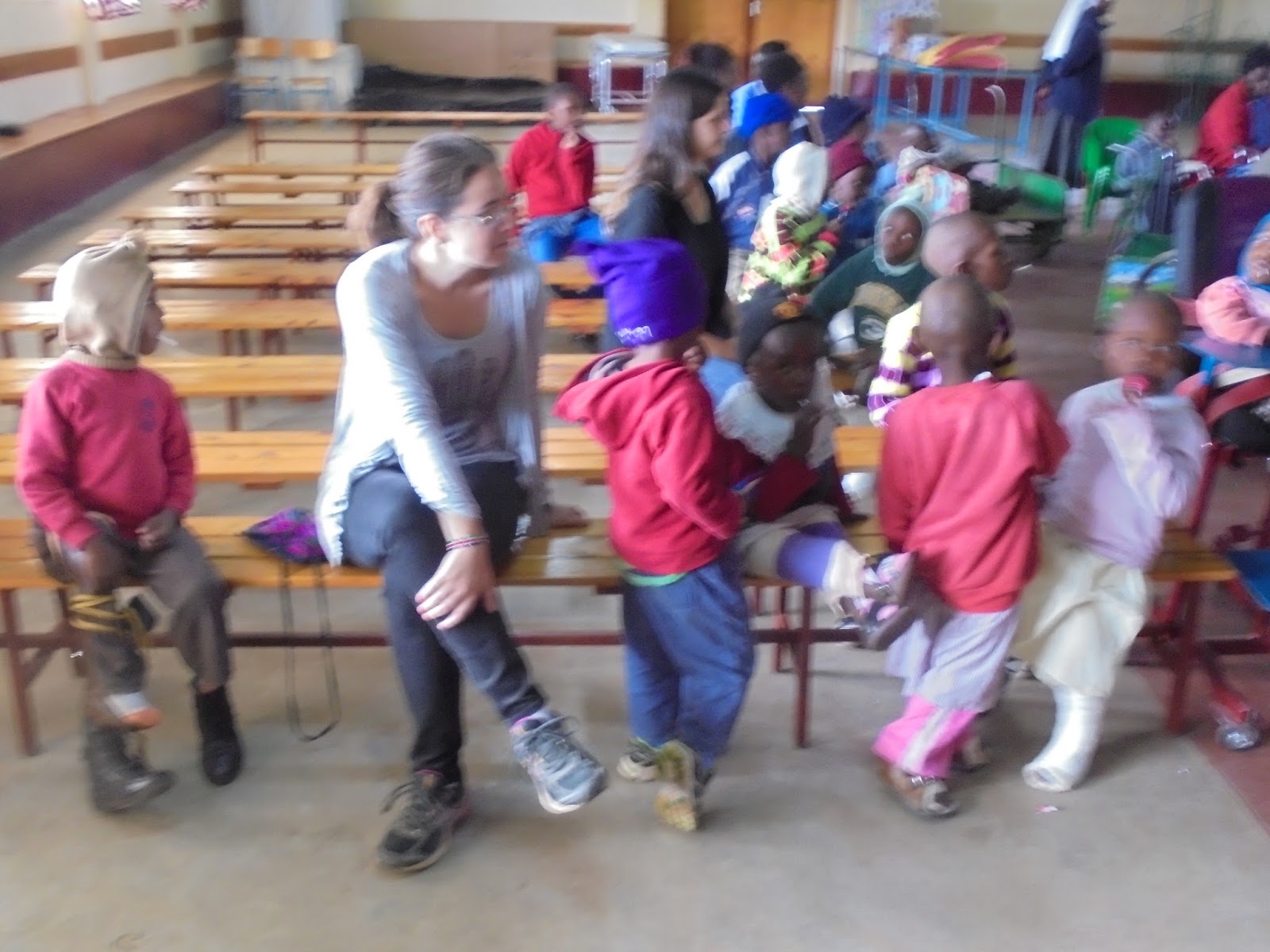
Was it that Saturday visiting the disabled children's home, when little Austin grabbed my wrist?

Was it the morning on Mount Kenya, exhausted in every part of the body but watching as the sun rose, illuminating every corner of that majestic mountain?

Was it that day, walking along the market stalls filled with fresh mangoes, cabbages, tomatoes, onions, spinach, avocados, potatoes, and more in all colours, that day when a thought just entered my head: 'I don't want to leave here. I want this to be my life.'?

Soon, my time here will only be a memory. Can I bear that? I don't know. I feel like there is still so much more to learn about this diverse land. There are so many languages I still don't know. There are so many dishes I still can't cook. I miss my Nova Scotia home, of course. Nowhere feels like home like those rugged shores. But here I am. I don't want to leave. I have visited a few places on this vast planet, but have rarely felt like this. I am preparing myself to leave a place I love, and I don't know when I can return. I know this whole post just reeks of sentimentality. But guys, our stay on Earth is short. Let's appreciate every moment. Today in church, as I listened to the wise teaching of the guest speaker, a thought occurred to me, a truth that Jesus speaks throughout the Scriptures, I think, but that I never put into words, until now. The thought is this: On my deathbed, I don't think I will be wishing that I had loved less. God has been showing me lately that though love is usually the difficult way, it is always the best way. So, though it is painful to say goodbye to this country and its residents, many of whom I can now call friends, I know that the time here and this love was worth the pain.

Wednesday, February 8, 2017

Week 14: Peak experience

This week's blog post is a bit different as this past weekend was a bit different! A team from the office trekked Mount Kenya. I really feel like there are so many aspects of this weekend that I don't wish to forget. It was the most physically challenged I have been in recent memory, but I also experienced some of the most beautiful scenes I have ever seen. You know I really think I have seen the best of Kenya: from snorkelling at Kisite Marine Park to watching the sunrise at the top of Mount Kenya, this country continues to take my breath away.

Mount Kenya is the tallest mountain in the country, and second highest on the continent, following Mount Kilimanjaro. This mountain is sacred to the Kikuyu people. As an office, we had been planning on climbing it for some time.

Spending a weekend away from civilization was exactly what I needed at this time. I had become extremely obsessed with US politics, and every time I opened twitter or reddit I would be shocked and enraged by one piece of world news or another. I was overwhelmed with the injustice in the world and yet media availed me with a constant stream of injustice. It was toxic. Spending three days with no network and in one of the most naturally beautifully places in the world was the best reset I could have. I felt like God was saying "I made this world. And nobody can destroy it without my consent."

Even on the mountain, though, injustice was not hidden: the guide pointed to a valley and said "There used to be a glacier there, but... global warming." I knew these glaciers provide water for the people below.
But the mountain still remained. It was large and strong and I think of the Bible verse that says "if you have faith the size of a mustard seed, you will say to this mountain, ‘Move from here to there,’ and it will move.'" Seeing the majesty and strength of Mount Kenya, this mountain where people have disappeared without a trace, this fortress of stone and ice, this verse comes to life. The mountain nearly conquered us, and we were not moving it: just walking on it. Imagine that just a little faith in our God can move that mountain! It shows his great power.

So, let me show you some photos and tell you the story of Mount Kenya!

We had so much energy on Day 1. The road to camp was paved, so it was just a long uphill walk. The team consisted of six folks from Baraka and one Czech gentleman, along with our guide, cook, and porters. We were so excited and we just enjoyed the whole time. We arrived at camp early and, crazy as we were, decided to take a little jog and an extra hike up to a meteorological station. The below photo is taken from that meteorological station. If I would do it again, I probably would have chosen not to hike more than absolutely necessary. But at the time, I was just a mountain rookie, naively giddy and excited, with no idea what was in store in the coming days.
The first night was basically "glamping." The porters set up our tents for us and prepared an enormous meal. Unlike other times I have been camping, I was not responsible for anything: not cooking, cleaning, setting up the campsite, or anything. All we had to do was hike. At night, we warmed ourselves around a campfire, drinking hot tea and telling stories. The campfire was necessary, as we were at a high altitude, and the climate was cool. This coldness actually made it hard for me to sleep, as if I was camping in the spring or fall in Nova Scotia. But I did not complain when I woke up for this sunrise.
 
Day 2 began with this incredible sunrise, and continued to give incredible views throughout the 14km of hiking. We meandered through valleys reminiscent of the moors I had traversed in England just a few months ago.
 
Then there is this amazing place, where we emerged out of the valley to see our first real glimpse of the mountain peaks. I will just let the photos of the viewpoint speak for themselves.

After constant uphill walking and little sleep, rest points typically looked like this along the way. It was such a relief to sit down for a minute, and take some water. Even if I was in shape (which I wasn't, let's be honest), this would be a tough climb because of the altitude. The oxygen in the air really is reduced the more you climb, and many people on the team felt various symptoms of altitude sickness. So in fact frequent stops and water breaks were absolutely vital.
 Here's a view walking through the valley.

We finally reached camp just as we felt snow and hail falling. In this case, we were staying in the lodge. I cannot imagine if we tented that night, as the cold was unbelievable. I was worried for my Kenyan colleague who had never experienced cold like that before. But he survived, as did we all. We drank lemon tea and ate a hearty meal and went to bed very early. I slept in a huge down jacket: that's how cold it was! I love this photo of the whole Baraka team at the camp.
Day 3 began at around 2:30am, when our guide, Mohammed, woke us up. We groggily took some tea and checked our equipment before exiting the relative warmth of the camp. It was 3am, and I was cold and sore and dirty. But when I saw the stars, I forgot about all that. It was the dead of night. I was in one of the most wild places I have ever been, and all was silent. The black silhouette of the mountain rose in front of me, surrounded by thousands of stars. "Wow," was all I could say, and I know it was not enough. Sometimes words just cannot express the beauty of the stars. 

The next three hours were a blur: my headlamp illuminated only the steps in front of me, the only sound was the trudge of many boots on rocks and snow. My breathing was heavy and methodical: first "Hal-le-lu-jah," but then quickly changing to "Oh-God-Oh-God." Every step was like a stretch to muscles I had forgotten existed. I felt only primal needs: to breathe, and to drink water. I wondered if we would make it to the top. I wondered if it was worth it.

But then, all of a sudden, we reached the top. We climbed to the summit and there, the sun was rising beyond the clouds. I started crying. The beauty overwhelmed me. I was crying in part, I think, because I had not thought I would make it. I was crying because we had, and it was totally worth it. Hakuna mungu kama wewe.

 Here's a photo of me and my enormous coat at the top of Mount Kenya.
 The way down was as much of a challenge as the way up, for someone with knees like mine! But as the way had been dark on the way up, I got to enjoy the scenery on the descent, slow as it was. Again, I really feel like this blog post cannot express the beauty of this place. The best words to describe how I felt about this place are "wonder" and "awe."

 And then, we had breakfast. It's not every day you can say you climbed to 4,985 metres before breakfast. On Sunday, this was the case for us. After breakfast, we walked all the way back to the first camp!
 Here is the whole Baraka crew, minus Donald, who is taking the photo. We look remarkably good for having just climbed a mountain and walked a few kilometres besides. I think we were just happy to be sitting down.
 Some members of the team still had energy enough to capture this sweet shot!

So friends, that is that. We climbed a mountain this weekend. I look at that mountain every day from Nanyuki, and now I can look it and say "I was there." I am still in a lot of awe from that. I am thanking God for creating that place, and for allowing us to see it.

Wednesday, February 1, 2017

Week 13: Hope

I think we all need a bit of hope these days.

It's been just over a week since a reality TV star became the US president, and already I am getting exhausted by all the injustice.
Last week the US barred Syrian refugees from entering their country, indefinitely.
A few nights ago an attacker (I don't know who) killed several people in a mosque in Quebec City.
The other night I watched 13th on Netflix. It is hard for me to explain this documentary. It was just the kind of film where you sit silent and unmoving for the entire duration of the final credits. The documentary was just wave after wave of being shocked by injustice that casually exists and is for the most part unchallenged.
Quote at the end of 13th:
“People say all the time, ‘well, I don’t understand how people could have tolerated slavery?’ ‘How could they have made peace with that?’ ‘How could people have gone to a lynching and participated in that?’ ‘That’s so crazy, if I was living at that time I would never have tolerated anything like that.’
And the truth is we are living in this time, and we are tolerating it.”
There is also a lot of injustice here in Kenya, by the way. There is corruption and blatant sexism and right now the doctors are on strike and that disproportionately affects the poorest people and people get put in jail for years and years for minor crimes and school fees are so prohibitive that some people can't even afford to send their children to secondary school and....

I am getting exhausted, because I cannot escape injustice. It sometimes seems like there is no choice but to tolerate it because to not tolerate it would require me to opt out of many of the systems of the world, systems that are pretty hard to escape. But I am at a point, personally, where I feel like I have no choice. Jesus said "By this everyone will know that you are disciples, if you have love for one another." So what does love for one another look like? What does bringing God's kingdom look like, here and now? And how can I have hope for God's Kingdom coming, when I see all these seemingly powerful unjust systems in the world?

Now, more than ever, we need hope. It is very easy to become discouraged. I wonder if the world will ever get better. But then...

Then I see a post on social media from a lady from my church at home. She is planning an event for the church ladies, and she wants to include making a quilt for the Syrian refugee family who will soon be arriving. The other ladies agree. I think of how some people in my church would have reacted to refugee sponsorship even just a few months ago. But now- people are gathering as a community to welcome strangers. What a beautiful picture of God's Kingdom.

Then I visit a primary school in rural Kenya. We are proposing a partnership with the school to support their feeding program. We talk about the importance of proper nutrition on learning in the school, and look around the grounds to see if there is a place where we can put a small farm. The head teacher agrees, and we form an enthusiastic partnership. Now, like in other schools in the area, the students can learn how to grow food, and they can benefit by eating that food at lunchtime daily. This will hopefully reduce drop-out rates and improve students' academic performance. 

Then I visit a young man, in class 8. This child is part of Chalice's child sponsorship program. "What do you like to do in your free time?" I ask. He answers, "Running." "What do you like to do with your friends?" I ask. He answers, "Running." I ask his favourite sport, and this, unsurprisingly, is running. Finally, I ask him what he wishes to do when he grows up. Of course, he wants to be a runner. I imagine turning on the TV someday to see him take gold in the Olympics.

Then Hannah, a lady that shares a name and not much else in common with me, welcomes me into her home. Her child is sponsored, and she is the secretary of the microfinance group. She has used the money from the microfinance group to start a small shop, and she is making money for her family from this shop. On her little land, she has a kitchen garden. After we visit, she sends us with a bag full of spinach. It feeds us for three days.

Then I attend church, the church I can now call my church home in Nanyuki after four Sundays. Like always, the children sing a couple of songs during the service. One of these songs is familiar to me: "All other Gods/They are the works of men/But you are the most high God/There is none like you." I think of how I heard children at Malagash singing that very same song this summer. I think of how some of those children singing are the daughters and sons of teenage mothers. I think of how the church has welcomed these unconventional families with open arms. I am thankful for such a church.

Jesus gives the ultimate hope, though. Jesus both died and rose from the dead, which tells me two things about him: One, he understands suffering and injustice. And two, he is more powerful than the most powerful thing we can think of. I am thankful that Jesus is allowing me to be a part, even in such a small way, of toppling injustice. 
It is actually impossible to be discouraged when you get to be around this much cuteness
Just another sunset

So much love for these precious ones (Visit to the disabled children's home).